Following the Dice Into the Map: Starting a Watercolor System Inspired by Jerry Gretzinger
I’m calling my version of this project Jerry Meandering.
The blog is Meandering Atlas.
The basic idea is that I want to make a map by wandering through it instead of planning the whole thing first. I want rules, randomness, watercolor, sketching, mistakes, terrain, worldbuilding, and eventually probably cards. But mostly I want to actually start.
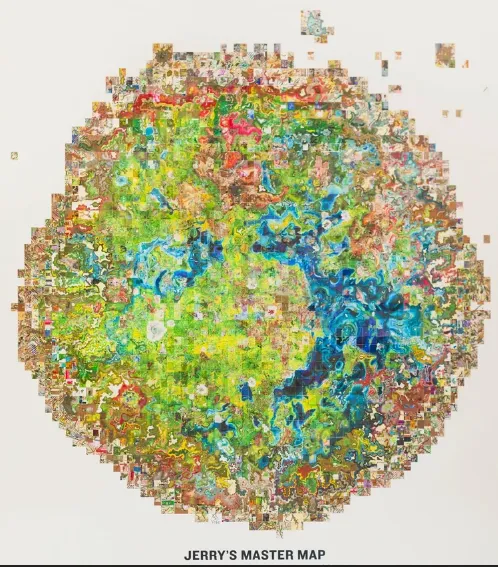
This is very directly inspired by Jerry Gretzinger’s Jerry’s Map, which is the reason I’m calling it Jerry Meandering. Jerry’s map is the main spark: a huge imagined world that keeps growing and changing through a rule system, where the artist follows instructions and the map becomes something stranger than one person would probably design on purpose.
The more immediate push came from Pekka Marjamäki’s Suolenkainen’s Map posts: “Creating a Unique Procedurally Generated Map: An Artistic Journey Inspired by Jerry Gretzinger” and “The First Tiles: A Proof of Concept”. Those posts helped me see a version of this that could start messy and physical before the whole system is finished.
I’m not making wooden hex tiles right now. I’m not starting with a finished card deck either.
I’m starting with the watercolor paper I already have.
And dice.
Why Dice First
Eventually I think this wants to become a deck.
I like cards. I like drawing them. I like the idea that one card could mean different things depending on the layer of the map. I like the idea that the cards themselves slowly become decorated through play.
But I also know that if I start by making the perfect deck, I may just spend forever making the deck.
So the dice are the ugly first version of the system.
They let me begin now.
The cards can come later, and maybe they will be better because they grew out of actual mapmaking instead of me trying to design everything before I know what the project is.
The Basic Roll
Each session starts with six dice.
Each die has a job.
Blue is the watercolor die. This decides the painting move: wet-on-wet, wet-on-dry, drybrush, wash, bloom, glaze, lifting, staining, or whatever else ends up on the table.
Green is the feature die. This decides what kind of map thing I’m dealing with: water, elevation, forest, field, coast, road, settlement, ruin, border, or something stranger.
Yellow is the shape or placement die. This decides how the thing appears: clustered, stretched, central, edge-bound, scattered, crossing, curved, broken, hidden, repeated, or bleeding outward.
Red is the line, mark, or interruption die. This is where the map gets outlined, cut, masked, inked, textured, divided, punctured, bordered, or otherwise complicated.
Brown is the decision die. This handles quantity and forks in the road: how many, how far, which direction, which neighbor, whether I keep going, whether I modify something old or create something new.
Black is the meta die. This is for the practice around the map: repaint an old panel, shuffle (for now, the tables up), annotate on the map, do deck work, think of card ideas, prepare.
I like that the black die exists because I don’t want the “real project” to be only the finished map.
The notes, cards, rule changes, photos, and weird little records are part of it too.
The Layers of the Map
The first layer is the terrain layer.
This is the first watercolor pass. It is where the blank paper stops being blank and starts becoming land, water, height, weather, coast, marsh, shadow, or whatever the paint suggests.
I’m not trying to make a clean fantasy map immediately. I’m trying to make terrain accidents on purpose.
A bloom might become a lake. A tide mark might become a shoreline. A drybrush scrape might become high ground. A pale wash might become sand, fog, grassland, or shallow water. A hard edge might become a cliff, wall, road, or border later.
After that comes the feature layer.
This is where I start reading the watercolor as a map. I decide what the terrain is becoming: rivers, ridges, forests, fields, islands, roads, ruins, harbors, settlements, bridges, walls, shrines, or places I do not understand yet.
Then comes the sketch layer.
This is where I draw the map into focus. Pencil, pen, ink, labels, little structures, roads, coastlines, hatching, paths, symbols, borders, and all the marks that make it feel more like a map and less like a painting.
Then comes the living layer.
This is where it becomes a world: names, factions, rumors, old disasters, migrations, festivals, taboos, trade routes, local arguments, sacred places, abandoned projects, laws, cover-ups, and whatever else makes the place feel lived in.
I like the idea that the same result can mean different things at different layers.
So wet-on-wet might literally mean wet paint moving through wet paint in the terrain layer. But in the living layer, it might become the Bloom: a rumor, settlement, forest, belief, disease, migration, cult, fashion, or empire spreading softly outward.
Wet-on-dry might start as a sharper painting technique. But later it might become the Mask: a border, cover-up, planned district, sealed ruin, official story, artificial order, or political lie.
That is the part I’m most interested in.
Not just “roll to place a forest.”
More like: the art move becomes the world move.
Axes and Quadrants
One thing I liked from Suolenkainen’s proof of concept was the extra randomness before the art even starts.
I want some of that.
Each sheet of watercolor paper can have its own temporary geometry. Not a perfect grid. More like a private compass for that session.
A session might start like this:
- Roll the six dice.
- Add the dice together.
- Use that number to create a base angle.
- Mark north on the page.
- Place an anchor point somewhere on the page.
- Draw one axis through the anchor point at the base angle.
- Draw a second axis across it.
- Now the page has four quadrants.
- Use the dice to decide which quadrant gets changed.
The point is not that this is mathematically elegant.
The point is that it keeps me from always putting the interesting thing exactly where I would naturally put it.
The page gets a center of action. The dice choose a direction. The quadrant tells me where to work. Then I have to respond.
That feels right.
How a Turn Works
A turn should be small.
I roll the dice.
I log the results.
I find the target: a new sheet, an old sheet, a quadrant, an edge, a previous feature, or a neighboring area.
Then I apply the result to the current layer.
If I’m in the terrain layer, I paint. If I’m in the feature layer, I interpret the paint. If I’m in the sketch layer, I draw. If I’m in the living layer, I worldbuild. If the black die tells me to step away from the map, I do that instead.
The goal is not to finish a beautiful map in one sitting.
The goal is to change something and record what changed.
That feels closer to what I actually want. The map is not a product. It is an ongoing situation.
Bleeding
I definitely want bleeding.
A thing should not always stay where it starts.
If a river hits the edge of the page, it might need to continue somewhere else. If a road leaves one panel, another panel has to answer. If a mountain range appears, nearby places may change around it. If a settlement grows, it might pull roads, fields, shrines, borders, and conflicts toward itself. If a coastline cuts across one sheet, the next sheet may have to admit that the sea is there too.
Bleeding keeps the map from becoming a bunch of separate little drawings.
It makes consequences.
It also means the dice can send me back to places I thought were done.
Good.
What I Need to Start
For now, I do not need the full deck.
I do not need all the rules.
I do not need a complete world.
I do not need to know what the map is “about.”
I need:
- watercolor paper
- watercolor paint
- a pencil or pen
- six dice
- a log
- a way to archive versions
- enough patience to let the first version be ugly
That is probably enough.
The first version of Jerry Meandering is just this:
roll the dice, make a mark, record what happened, let the randomness decide.
Next: P001: The First Terrain Layer →